Science
 Aim
Aim
- To begin their GCSE science course
- To engage students’ curiosity
- To develop students’ mathematical skills
- To continue developing students’ practical and investigative skills
Topics covered
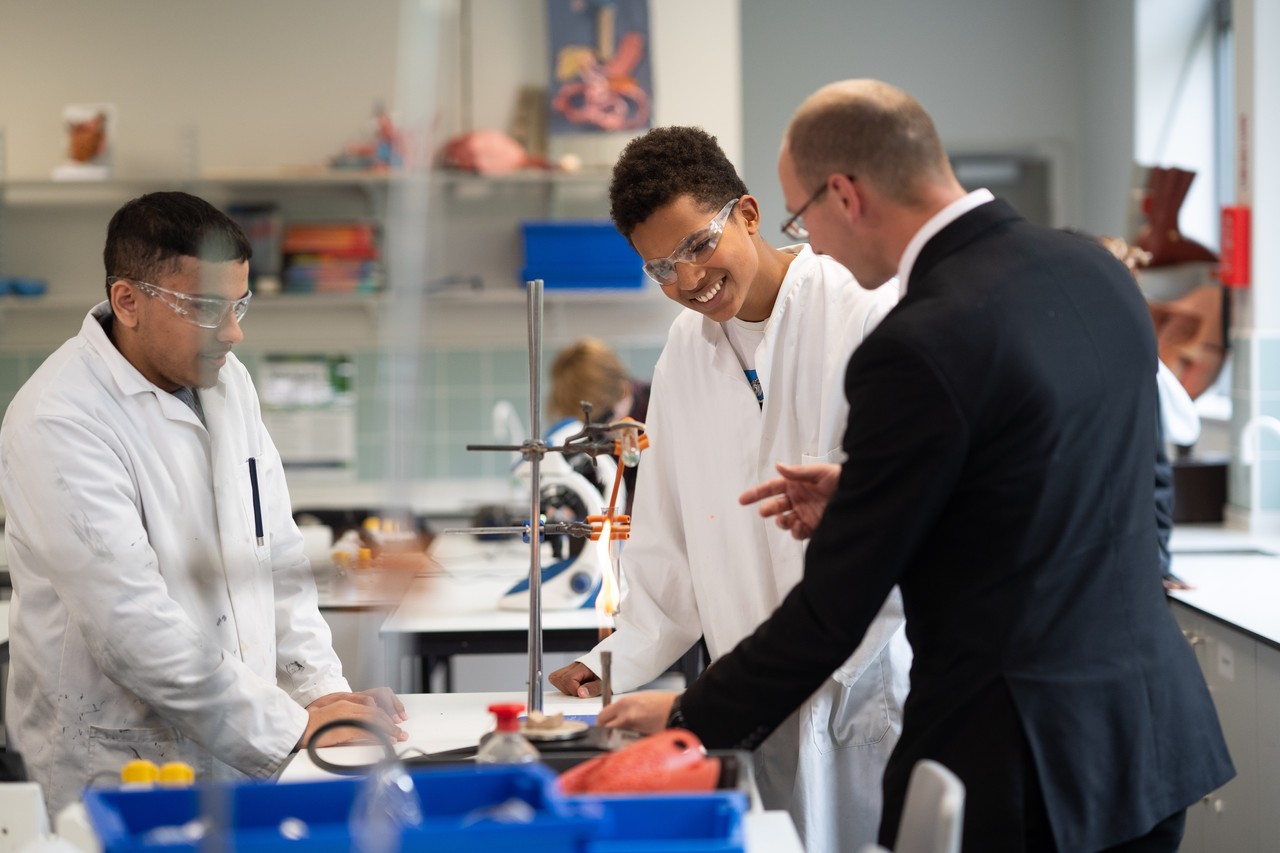
In Year 9, all students begin their GCSE course in Science (following the AQA GCSE course). Students will either be entered for the separate sciences course (three GCSE qualifications) or for combined science (trilogy), but this won’t be decided until Year 10 and Year 11.
Students are taught Biology, Chemistry and Physics separately by specialist teachers and will cover the following topics:
Biology
- Unit 1: Cells
- Unit 2: Organisation
- Unit 7: Ecology
Chemistry
- Unit 1: Atomic structure and the periodic table
- Unit 2: Bonding, structure and the properties of matter
- Unit 9: Chemistry of the atmosphere
- Unit 10: Using resources
Physics
- Unit 1: Energy
- Unit 2: Electricity
For information on the different courses, click here.
Teaching groups
Students are placed into sets at the start of Year 9 and are therefore taught in classes of similar ability students. This allows them to receive teaching which most closely matches their ability and needs. On each side of the year, there are two parallel set one classes and two parallel set three classes. On one side there is a further group for students who need more support in accessing the curriculum.
Assessment
Students will complete assessments at the end of each topic, allowing teachers to assess student progress. There will also be an assessment at the end of the year on content from the whole year. The result of this test will be used to determine students’ current attainment as well as in setting students for the following year.
How to support at home
- Buy your child a GCSE revision guide – the correct one will depend on the course your child will be entered for
- Support your child in completing homework on time and talking to them about what they have been doing in Science. Much of the homework set is online (using Seneca)
- Encourage students to watch documentaries about space and nature (for example, Planet Earth, Blue Planet and The Solar System). There are many available on BBC iPlayer or streaming services
The AQA specification can be found by clicking here.
If you want to view the content, then you can use BBC Bitesize by clicking on the following links: