Chemistry (OCR)
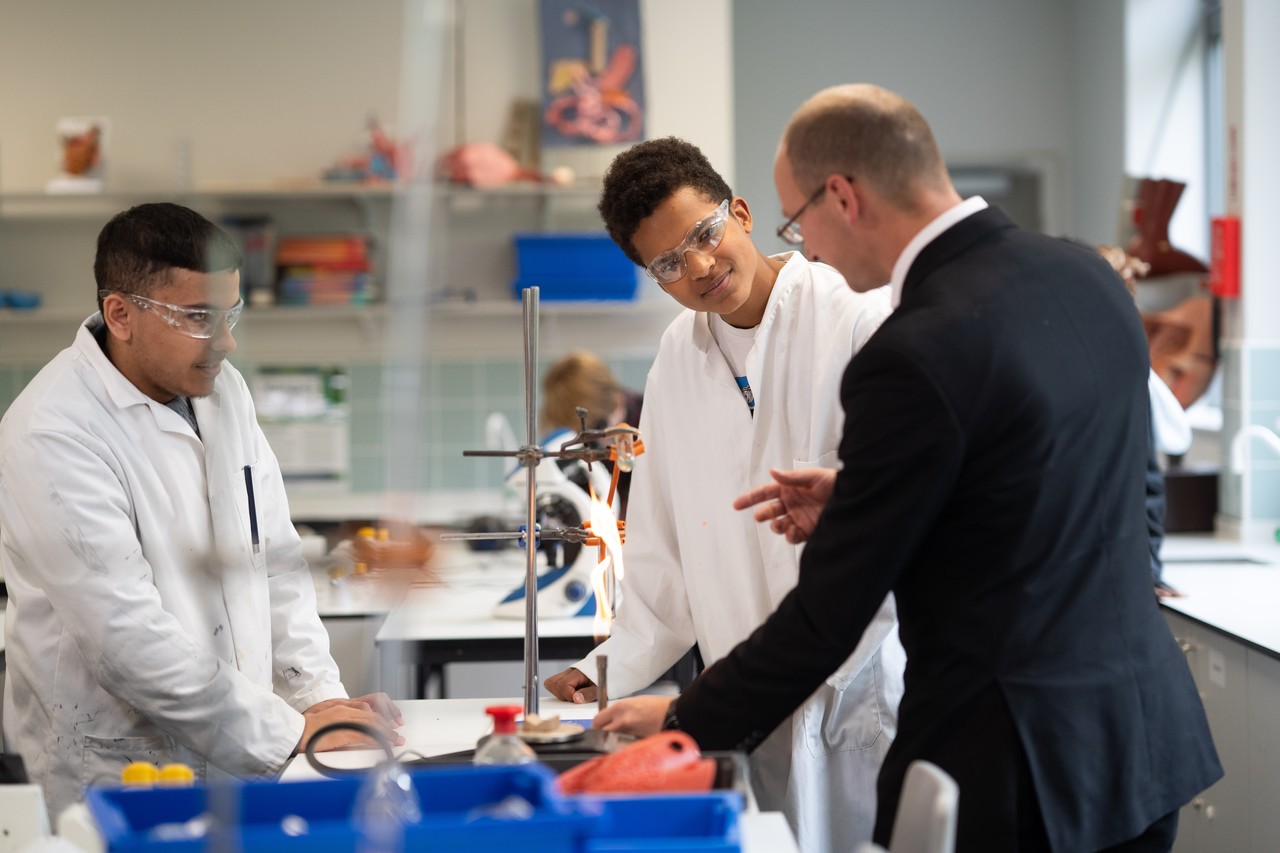
What do I need to study Chemistry?
To be accepted onto the course you must have a minimum of a Grade 6 in GCSE combined Science or a grade 6 in GCSE Chemistry plus a Grade 6 in another science. Also a Grade 6 in mathematics.
What does the course involve?
Our A level course is a 2 year course based on the OCR specifications for Chemistry.
Y12 content
Module 1: Development of practical skills in Chemistry
- Skills of planning, implementing, analysis and evaluation
Module 2: Foundations in Chemistry
- Atoms, compounds, molecules and equations
- Amount of substances
- Acid-base and redox reactions
- Electrons, bonding and structure
Module 3: The periodic table and energy
- The periodic table and periodicity
- Group 2 and the halogens
- Qualitative analysis
- Enthalpy changes
- Reaction rates and equilibrium (qualitative)
Module 4: Core Organic Chemistry
- Basic concepts
- Hydrocarbons
- Alcohols and haloalkanes
- Organic synthesis
- Analytical techniques (IR, MS)
Y13 content
Module 5: Physical Chemistry and transition elements
- Reaction rates and equilibrium (quantitative)
- pH and buffers
- Enthalpy, entropy and free energy
- Redox and electrode potentials
- Transition elements
Module 6: Organic Chemistry and analysis
- Aromatic chemistry
- Carbonyls chemistry
- Carboxylic acids and esters
- Nitrogen compounds
- Polymers
- Organic synthesis
- Chromatography and spectroscopy (NMR)
How is Chemistry examined?
| Module | Assessment |
|---|---|
| Periodic table and elements and Physical Chemistry (01) |
|
| Synthesis and analytical techniques (02) |
|
| Unified Chemistry (03) |
|
| Practical endorsement in Chemistry (04) |
|
What will I be able to do with an Advanced Level qualification in Chemistry?
Chemistry opens up a world of possibilities and expands your career choices. Chemistry is often called the central science. It links with all the other sciences and underpins many branches of technology from silicon chips to brewing.
Chemistry has something for everybody. Whether or not you want to study after you leave school, there are opportunities to begin a career with Chemistry. Once you have a Chemistry qualification you may be surprised at just how many places you could end up working. Here are some examples:
- Manufacturing industries including textiles, cosmetics, personal products, pharmaceuticals, food, brewing, detergents and agrochemicals – in research and development, production, waste management and pollution control, quality control, marketing, sales and technical support and general management
- In the community – as a doctor, dentist, vet or physiotherapist – alternatively, in the pathology and biochemistry laboratories of hospitals, in government and police forensic science laboratories or as a public analyst
- Commerce – in accountancy, banking, computing, sales and marketing, personnel, publishing and patent law
- Education – as a teacher or technician in a school, college or university
Not all chemists wear white coats and work in laboratories. The range of jobs available to someone with a chemistry qualification is greater than for most other qualifications. Many employers recognise the value of training in logical thought, problem solving and in numerical and communication skills that forms an integral part of all chemistry courses. If you are thinking of university, chemistry is a good choice of subject to study at A2 level. It is listed as a preferred subject for more degree subjects that any other subject.
For example:
| Course | Place of chemistry in the preferred subject list |
|---|---|
|
CHEMICAL SCIENCE Biochemistry, Chemistry, Environmental Chemistry, Marine Chemistry, Medical and Pharmaceutical Chemistry, Colour Chemistry |
First |
|
AGRICULTURE – FOOD SCIENCE Agriculture, Food Science, Soil Science, Animal Science, Crop Protection, Forestry |
First |
|
BIOLOGICAL SCIENCE Biology, Food Science, Marine Biology, Ecology, Botany, Zoology, Animal and Plant Biology |
Second |
| MEDICINE, DENTISTRY, VETERINARY SCIENCE | First |
|
MEDICAL SCIENCE Pharmacy, Toxicology, Pharmacology |
First |
|
ANATOMY, PHYSIOLOGY Anatomy, Pathology, Physiology, Neuroscience |
First |
| CHEMICAL ENGINEERING | First |