
Student reviews
There are a number of review points in Sixth Form. They help to keep everyone informed about your study progress and flag up concerns. You will be issued a copy of your review. Your parents/carers will also get a copy via email.
Progress review points
Year 12
- October – settling in/concerns review
- November - review 1
- February - review 2 with most likely outcome (MLO) grade and risk of failure intervention
- July - review 3 with Y12 exam grades and UCAS predicted grades
Year 13
- November - review 4 with updates to UCAS predicted grades if appropriate
- January - review 5 with January trial exam grades and MLO
- February - risk of failure intervention
- April – Review 6
Review quadrants
At review points two to six, students are grouped into quadrants based on their application and their progress.
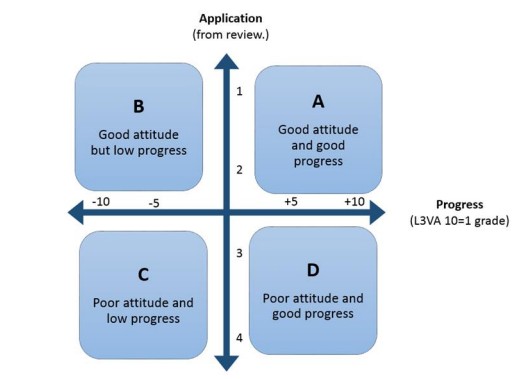
Targeted interventions take place with tutors through the tutorial system, or with your Pastoral Manager, Raising Achievement Leader or in departments. Some students are invited to weekly MAP tutoring sessions others might have a subject support contract.
Quadrant A
Good attitude and good progress. Well done – our high fliers. Have a look for independent learning resources to support your further progress. Normally about 160 students.
Quadrant B
Good attitude but low progress. Typically, about 90 students. Well done you are working hard but you need some subject specific advice from your tutor or class teacher. You’ll be a busy student, often organised but likely to need urgent support to make your study more effective. Retention of knowledge and application of the subject and examination skills need developing. Have you got effective revision plans? Are you accessing appropriate resources to support study? What targeted revision strategies are you using? What grades do you require for progression? Where are the gaps?
Quadrant C
Poor attitude and low progress. Perhaps 40 students. Intervention from department and Post 16 Team. More one to one support, MAP candidate. Possibly registered time in ILC/library. It would be helpful to set realistic improvements in forthcoming assessments. You might be given an Academic Improvement Plan (AIP) and have a parental meeting in school.
Quadrant D
Poor attitude and good progress. The students who despite doing limited work, do well. We normally get a handful of these in a cohort of 300. Intervention from department and Post 16 Team is required and how to find the motivation to engage with learning and understand just how much progress could be made if they improved their engagement. We will add achievement points after each review point to Satchel based on student application in lessons and application with independent work/homework. There is no surprise that students who are engaged with their learning make the most progress.
Risk of failure
It is in no one’s interest if we enter students for exams that they are likely to fail. After all the internal mock exams we will be working with heads of department to draw up lists of students who are at risk of failure. Students who fail the Year 13 January exams and have a MLO (most likely outcome) of a U grade are likely to be on this list. There will be targeted subject support leading up to Easter of Year 13 with definite improvements required. If by Easter, your teachers think that you are likely to end up with a U grade in a particular subject in the summer, you may be better focussing on one fewer subject. We will have a meeting about exam entries with you and your parents.